Table of Contents
ToggleQuality outdoor furniture isn’t cheap. A decent patio set can run anywhere from $500 to several thousand dollars, depending on materials and construction. Yet many homeowners treat protection as an afterthought, leaving cushions and frames exposed to UV rays, rain, snow, and debris year after year. The result? Faded fabrics, rusted frames, cracked wood, and an outdoor space that looks weathered long before its time. Patio covers are the simplest, most cost-effective way to extend the life of outdoor furniture, but only if homeowners choose the right type, fit them properly, and maintain them correctly.
Key Takeaways
- Patio covers for furniture can extend the life of a $2,000 investment by five to ten years, making a $100 cover set an excellent return on investment compared to replacing sun-damaged or rusted components.
- UV rays, moisture, temperature swings, and debris damage outdoor furniture year-round—not just in winter—making continuous protection essential even in summer months and high-altitude climates.
- Quality patio covers should feature a UPF 50+ rating, taped seams, ventilation panels to prevent condensation buildup, and secure fastening systems like drawstrings or click-close buckles to withstand wind and weather.
- Proper fit is critical: measure furniture including cushions and add 2-6 inches of clearance; covers that are too tight will tear while oversized covers allow wind penetration and water pooling.
- Regular maintenance—such as monthly hosing and air-drying covers completely before storage—preserves water resistance and extends the lifespan of patio covers from three to seven years for quality options.
Why Your Patio Furniture Needs Protection Year-Round
Even furniture marketed as “weather-resistant” or “all-weather” suffers from prolonged exposure. UV radiation breaks down polymer chains in synthetic fabrics and plastics, causing brittleness and color fade. Moisture, whether from rain, snow, or morning dew, penetrates wood grain, rusts metal hardware, and encourages mold growth on cushions and wicker. Temperature swings cause expansion and contraction in materials, stressing joints and finish coatings.
Many DIYers assume furniture only needs covering in winter, but summer sun can be just as damaging. A single season of unprotected exposure in high-altitude or southern climates can fade cushion fabric by several shades. Pollen, tree sap, and bird droppings add to the wear, creating stains that become permanent if not cleaned promptly.
Covers act as a barrier against all these factors. Quality covers block up to 98% of UV rays, shed water rather than absorbing it, and prevent debris accumulation. They also reduce cleaning frequency, an uncovered set might need scrubbing every two weeks during spring pollen season, while a covered set can go months between deep cleans. For furniture with removable cushions, covers eliminate the need to haul cushions indoors after every use, a convenience factor that shouldn’t be underestimated.
The return on investment is straightforward: a $100 set of covers can extend the life of a $2,000 patio set by five to ten years. That’s a far better deal than replacing sun-damaged cushions every other season or dealing with rusted frames that can’t be salvaged.
Types of Patio Covers for Different Furniture Pieces
Individual Furniture Covers
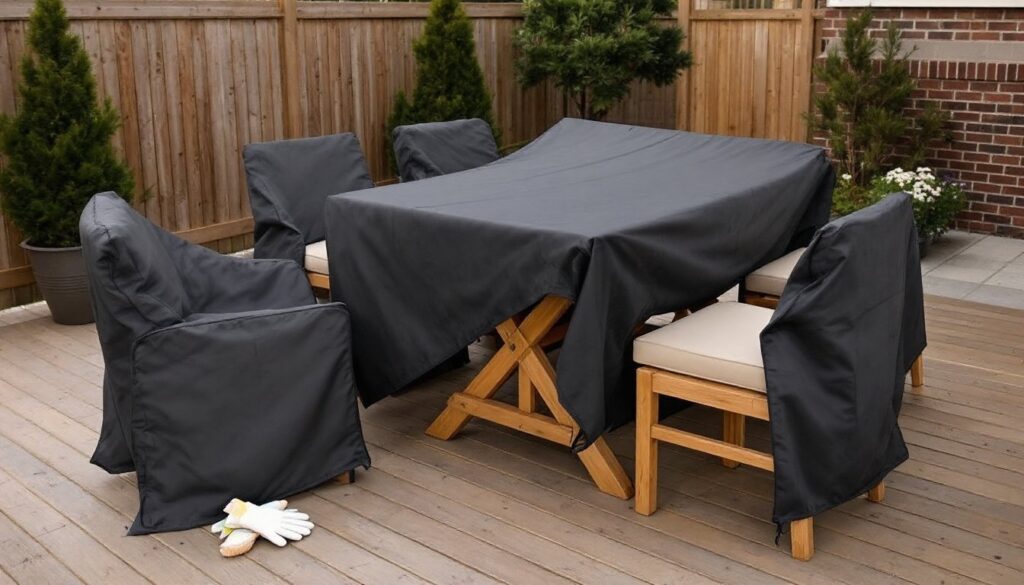
Individual covers fit specific furniture pieces, chairs, loveseats, chaise lounges, tables, fire pits, or grills. They’re cut to the general shape and dimensions of each item, with elastic hems, drawstrings, or buckle straps to secure them in place.
Best for: Mixed furniture sets where pieces get moved around frequently, or when only certain items need protection (like covering a grill and fire pit but leaving lightweight resin chairs uncovered). Also ideal for high-value pieces such as teak dining tables or premium lounge chairs that justify dedicated, tailored protection.
Material options include polyester (budget-friendly, decent water resistance with a coating), solution-dyed polyester (better UV resistance, color won’t fade), vinyl-backed polyester (adds waterproofing but can trap condensation), and breathable polyethylene weaves (excellent water resistance with airflow to prevent mold). Heavier fabrics (6–12 oz per square yard) hold up better in wind and last multiple seasons.
Look for covers with vented panels or mesh inserts. Without ventilation, condensation builds up inside, creating the same moisture problems the cover is supposed to prevent. Reinforced corners and double-stitched seams are non-negotiable, cheap covers tear at stress points within a season.
Full Patio Set Covers
Full set covers drape over an entire furniture grouping, typically a table with four to six chairs pushed in around it. They’re essentially large tarps tailored for outdoor dining or seating sets, secured with drawstrings or elastic.
Best for: Furniture that stays in one configuration most of the time, like a dining set on a deck or a sectional arrangement that doesn’t get rearranged. They’re faster to deploy than covering each piece individually and often cost less than buying five or six separate covers.
Downside: If a homeowner needs access to just one chair or wants to use part of the set, the entire cover has to come off. They also require the furniture to be arranged compactly, chairs tucked in, cushions stacked, or the cover won’t fit properly. Wind can get underneath if the fit isn’t snug, turning the cover into a sail.
Heavy-duty options (10+ oz fabric) work for permanent or semi-permanent setups. For sets stored on open patios in high-wind areas, adding tie-down straps or bungee cords through built-in grommets prevents the cover from blowing off. Some homeowners also weight the bottom edges with sandbags or PVC pipe to keep things tight.
Key Features to Look for in Quality Patio Furniture Covers
Waterproofing vs. water resistance: Water-resistant fabrics shed light rain but will soak through in a downpour or after prolonged exposure. Waterproof materials (vinyl-laminated or heavy polyethylene) block moisture completely but often trap condensation. The sweet spot is a water-resistant fabric with taped seams and ventilation, it sheds most water while allowing trapped moisture to escape.
UV protection rating: Look for covers labeled with a UPF (Ultraviolet Protection Factor) of 50+, which blocks at least 98% of UV radiation. Solution-dyed fabrics hold up better than surface-coated ones, which can flake or wear off over time.
Breathability: Mesh panels, vented tops, or micro-porous fabrics prevent mold and mildew by allowing airflow. Covers without ventilation are only suitable for very dry climates or short-term use.
Secure fastening systems: Elastic hems work for lightweight furniture but slip off bulkier pieces in wind. Drawstrings with cord locks provide adjustable tension. Click-close buckles or Velcro straps add security for odd-shaped furniture or high-wind areas. Covers without any fastening system are nearly useless in anything more than a light breeze.
Reinforced construction: Double-stitched seams, reinforced corners, and bartacked stress points (where straps or drawstrings attach) prevent tearing. Cheap single-stitch covers often fail at seams before the fabric wears out.
Handles or pull tabs: Makes removing and repositioning covers easier, especially on large or heavy items. Sounds minor, but wrestling a wet, heavy cover off a sectional without handles is frustrating.
Color: Lighter colors (tan, gray, beige) reflect heat and show dirt, but they resist UV fading better than dark colors. Dark covers (black, navy) hide stains but can get hot enough in summer sun to damage furniture finishes underneath. Medium tones are the compromise.
How to Properly Measure and Fit Your Patio Covers
Ill-fitting covers don’t protect, they flap in wind, let water pool, and wear out fast. Measure before buying, even if the furniture came from a big-box store with “standard” dimensions. Manufacturers’ listed sizes often don’t account for cushions, armrests, or decorative features.
For chairs and loveseats, measure:
- Width: Widest point, usually the armrests, from outside edge to outside edge.
- Depth: Front of seat to back of backrest.
- Height: Ground to highest point (top of backrest or cushion).
For tables, measure diameter or length/width, then height. Add 2–4 inches to table measurements if chairs will be tucked underneath the cover.
For sectionals or daybeds, measure the entire footprint as one piece, including any extended chaise portions.
Cover sizing usually lists dimensions as L x W x H (length x width x height). Choose a cover that’s 2–6 inches larger than the furniture on all sides. Too tight and it won’t fit over cushions or will tear: too loose and wind gets underneath. If measurements fall between standard sizes, go larger and use drawstrings or straps to cinch it down.
Fitting tips:
- Clean and dry furniture before covering. Dirt and moisture trapped under a cover accelerate damage.
- For cushioned furniture, either remove cushions and store them separately (best option for longevity) or ensure the cover is tall and wide enough to accommodate them.
- Pull covers taut but not stretched. Over-tensioning stresses seams and fabric.
- Secure all straps, buckles, or drawstrings. A half-secured cover is worse than no cover, it’ll abrade the furniture as it flaps.
- Check for water pooling on flat surfaces after the first rain. If water collects on top of the cover, add a support underneath (an overturned bucket or PVC frame) to create a slope for drainage.
Maintaining and Storing Your Patio Furniture Covers
Covers need maintenance, too. Dirty covers lose water resistance as grime clogs fabric pores, and UV coatings break down faster when covered in debris.
Cleaning:
- Shake or brush off loose dirt, leaves, and pollen every few weeks.
- Hose down covers monthly during heavy-use seasons. Use a soft brush and mild dish soap for stubborn stains. Avoid harsh detergents or bleach, they degrade waterproof coatings.
- Let covers air dry completely before putting them back on furniture or storing them. Folding a damp cover traps moisture and encourages mildew.
- Never machine wash or dry unless the manufacturer explicitly allows it. Most covers are too large for home machines, and the agitation can damage seams and coatings.
Seasonal storage:
- When covers aren’t needed (if furniture is brought indoors or in very mild climates with dry seasons), clean and dry them thoroughly.
- Fold loosely rather than cramming them into tight spaces. Creases can crack waterproof coatings over time.
- Store in a dry, ventilated space, garage shelf, shed, or basement. Avoid damp crawlspaces or outdoor storage boxes where moisture can accumulate.
- Some covers come with storage bags. If not, a large mesh laundry bag or breathable tote works. Avoid sealed plastic bins unless the cover is bone-dry.
Inspection and repair:
- Check seams, straps, and fabric for wear at the start and end of each season. Small tears can be patched with seam sealer or repair tape designed for outdoor fabrics (available at camping or marine supply stores).
- Replace covers when fabric becomes brittle, coatings flake off, or seams fail in multiple places. A cover that leaks or tears easily isn’t doing its job.
Quality covers should last three to seven years depending on climate, material, and maintenance. Budget covers might only make it one or two seasons, which makes them a false economy compared to mid-range options that cost a bit more upfront.