Table of Contents
ToggleSmall bedrooms aren’t just a space challenge, they’re a furniture puzzle. Every piece counts, and the wrong choice can make a tight room feel like a storage unit. The right small bedroom furniture doesn’t just fit: it works harder, stacks smarter, and opens up floor space that cheaper, bulkier alternatives swallow whole. Whether tackling a city apartment, a converted attic, or a kid’s room that’s maxed out, these seven furniture strategies solve real problems without requiring a sledgehammer or a building permit.
Key Takeaways
- Small bedroom furniture must prioritize multi-function capability, vertical storage, and wall-mounted pieces to maximize limited floor space without sacrificing livability.
- Platform beds with built-in drawers and Murphy beds are game-changers for small bedrooms, instantly reclaiming 25–30 square feet while eliminating the need for separate dressers.
- Maintaining at least 30 inches of clear walkway around the bed prevents the room from feeling cramped and ensures proper circulation throughout the space.
- Tall, narrow chests and wall-mounted storage solutions deliver the same storage capacity as traditional dressers while using half the footprint in compact bedrooms.
- Skip matching bedroom furniture sets designed for small spaces—instead, mix purpose-built pieces that solve specific problems and anchor tall furniture to wall studs for safety.
- Space-saving alternatives like floating nightstands, folding chairs, and pegboard systems keep the room functional while maintaining the open feel that defines comfortable small bedroom design.
Why Choosing the Right Furniture Matters in Small Bedrooms
Square footage isn’t negotiable, but how it’s used absolutely is. Poor furniture choices in a small bedroom create circulation problems, dead corners, and visual clutter that makes the room feel smaller than it actually measures.
Clearance and flow dictate livability. Building codes don’t regulate bedroom furniture placement, but the 36-inch clearance standard used for accessible design is a solid benchmark. If there’s less than 30 inches of walkway around the bed, the room will feel cramped no matter what paint color is on the walls.
Proportional scaling matters, too. A standard 60-inch-wide dresser dominates a 10×10 bedroom, but a vertical chest of drawers or wall-mounted unit delivers the same storage in half the footprint. Small bedroom furniture works when it prioritizes multi-function capability, vertical storage, and pieces that float or mount rather than squat on the floor.
Skip the matching bedroom sets marketed for “cozy spaces.” Most are scaled-down versions of full-size furniture and still eat up too much real estate. Instead, mix purpose-built pieces that solve specific problems.
Multi-Functional Beds That Save Floor Space
The bed is the biggest single object in the room, so it better pull double duty.
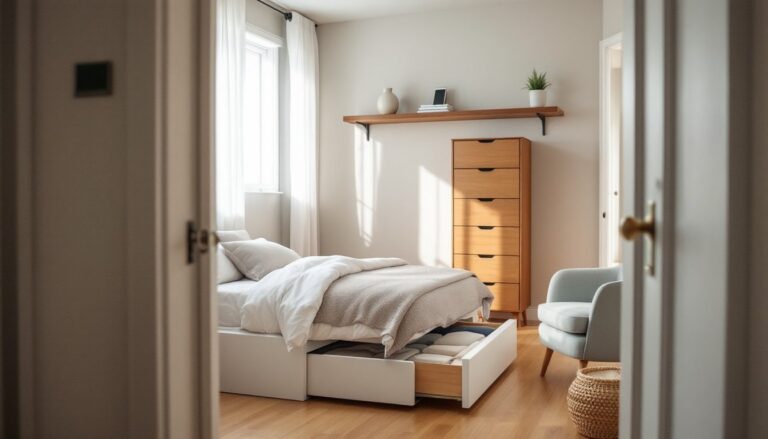
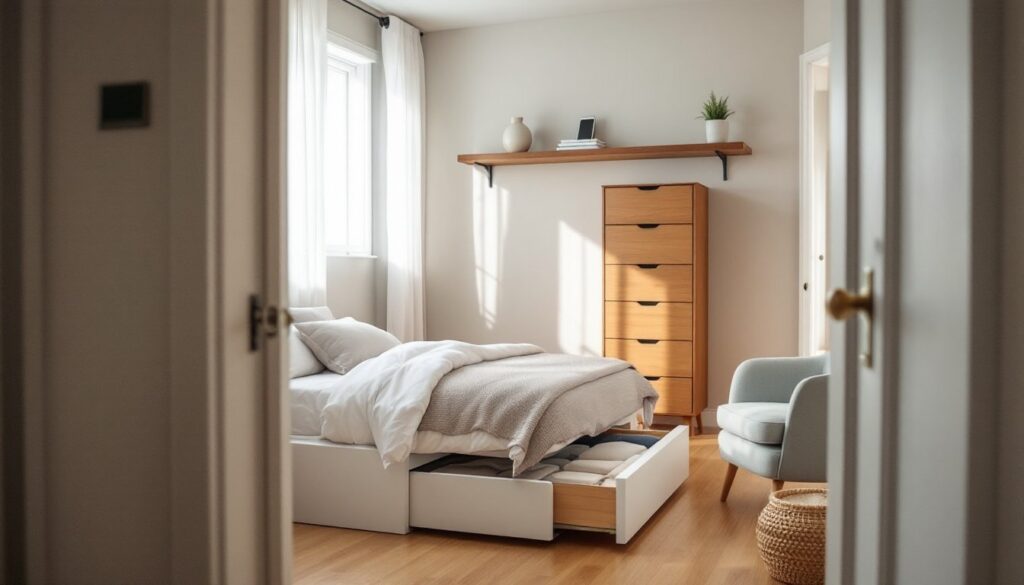
Platform beds with built-in drawers replace both a bed frame and a dresser. Look for models with four to six drawers on side rails or footboards. These aren’t flimsy particle board bins, quality units use plywood drawer boxes with metal glides rated for 75+ pounds. They handle off-season clothes, shoes, or linens without sagging.
Murphy beds (wall beds) fold vertically into a cabinet when not in use, clearing 25–30 square feet instantly. Modern mechanisms use piston lifts, not the old spring-loaded nightmare from cartoons. Installation requires locating wall studs and anchoring into at least two studs with lag bolts: drywall anchors won’t cut it. Some models include fold-down desks or shelving on the exterior cabinet face.
Loft beds lift the mattress 5–6 feet off the floor, creating a workspace, closet, or seating nook underneath. They’re not just for kids, adult-rated loft frames support 400+ pounds and use 2×4 or 2×6 construction with through-bolted joints. Ceiling height is the limiting factor: the International Residential Code (IRC) requires habitable rooms to have a minimum 7-foot ceiling. Measure twice: a lofted twin mattress plus frame typically needs 6 feet of vertical clearance, leaving minimal headroom in older homes with 7.5-foot ceilings.
If going the loft route, anchor the frame to wall studs for lateral stability. Freestanding models can rack or sway without proper bracing.
Compact Storage Solutions for Tiny Bedrooms
Closets in small bedrooms rarely hold everything, so auxiliary storage becomes non-negotiable.
Narrow dressers and tall chests trade width for height. A standard six-drawer dresser is 18 inches deep and 60 inches wide: a tall chest might be 18 inches deep but only 30 inches wide and 54 inches tall. Same drawer count, half the floor space. Look for dovetail joints on drawer construction and full-extension slides, anything less makes the back third of the drawer useless.
Under-bed storage bins work best with beds that have 10+ inches of clearance. Wheeled bins rated for 20–30 pounds slide out easily on carpet or hardwood. Avoid cheap plastic that cracks: polypropylene or canvas over a steel frame holds up better. For beds with less clearance, vacuum-storage bags compress bulky comforters and winter coats down to 3–4 inches.
Armoires and wardrobes function as closet overflow. A 36-inch-wide wardrobe with a hanging rod and shelves stores what won’t fit in the closet without the footprint of a traditional dresser. Solid wood or plywood construction beats MDF for longevity, especially if moving the piece later, particleboard doesn’t survive disassembly well.
Ottomans with lift-top storage hide throw blankets, books, or accessories. They’re not load-bearing seating for multiple people, but a well-built ottoman supports 200–250 pounds and doubles as a step stool or extra surface.
Space-Saving Nightstands and Bedside Alternatives
Traditional nightstands are 18–24 inches wide, manageable in a standard bedroom, space hogs in a small one.
Floating shelves mounted 24–30 inches above the mattress serve as minimalist nightstands. Use keyhole brackets or heavy-duty L-brackets screwed into studs. A single 1×8 or 1×10 board (actual dimensions 0.75×7.25 or 0.75×9.25 inches) cut to 18–24 inches long holds a lamp, phone, and alarm clock. Finish with polyurethane or wax to protect against water rings.
Wall-mounted swing-arm lamps eliminate the need for a lamp base on the nightstand, freeing up surface area. Hardwiring requires electrical skill: if the circuit isn’t already there, hire a licensed electrician. Plug-in swing-arm models are easier but need an outlet within 3–4 feet.
C-shaped side tables slide under the bed frame with the tabletop cantilevering over the mattress. They’re stable for drinks and small items but won’t handle heavy books or leaning weight.
Stacked crates or small stools work in a pinch. A 12×12-inch wooden crate turned on its side creates a cubby for books and a top surface for essentials. It’s not refined, but it’s functional and costs under $15.
Smart Seating Options for Small Bedroom Layouts
A bedroom chair sounds like a luxury, but it keeps clean clothes off the floor and gives a place to sit while putting on shoes.
Folding chairs disappear when not needed. Wooden or metal folding chairs with a 250–300-pound capacity lean against a wall or hang on a hook. They’re not lounge seating, but they’re fine for 10-minute tasks.
Upholstered slipper chairs have no arms, shaving 6–10 inches off the width of a standard accent chair. A typical slipper chair is 22–26 inches wide versus 30–36 inches for an armchair. Look for hardwood frames and sinuous spring support rather than webbing, which sags faster.
Storage benches at the foot of the bed combine seating with hidden storage. A 48-inch bench with a lift-top lid holds extra bedding or out-of-season clothes. Make sure the lid has a soft-close hinge to prevent finger pinching and frame damage.
Floor cushions or poufs aren’t structured seating, but they tuck under a desk or bed when not in use. They’re best for kids’ rooms or casual spaces.
Vertical Furniture and Wall-Mounted Pieces
When floor space is gone, look up.
Tall bookcases max out vertical storage. A 72-inch-tall bookcase holds as much as three short units but uses one footprint. Anchor tall furniture to the wall using furniture straps or L-brackets screwed into studs, tip-over accidents happen, especially with kids or pets. The Consumer Product Safety Commission recommends anchoring any furniture over 30 inches tall.
Wall-mounted desks fold down when needed and tuck flat when not. They’re ideal for small bedrooms doubling as home offices. Most fold-down desks support 30–50 pounds when open, enough for a laptop and notebook, not a desktop tower. Installation requires hitting at least two studs with 3-inch screws.
Pegboard or slat wall systems turn a blank wall into modular storage. Pegboard accepts hooks, shelves, and bins without new holes every time needs change. Install pegboard with 1-inch spacers behind it so hooks have clearance to fit. A 4×8 sheet of 1/4-inch pegboard costs $20–30 and cuts to size with a circular saw.
Hanging organizers and hooks on the back of the door recover dead space. Over-the-door shoe racks, jewelry organizers, or coat hooks don’t require tools, though screwed-in hooks hold more weight than over-door hangers.
Conclusion
Small bedroom furniture isn’t about making do, it’s about making smart choices that reclaim floor space and add function. Multi-use beds, vertical storage, and wall-mounted pieces turn cramped quarters into livable, organized rooms. Measure the space, anchor anything tall or wall-mounted into studs, and skip the furniture sets that prioritize matching over performance. The best small bedroom setup is the one that works hard and stays out of the way.