Table of Contents
ToggleMid century modern bedroom furniture continues to dominate interior design in 2026, blending clean lines, organic forms, and functional beauty that never goes out of style. Born from the design revolution of the 1940s through 1960s, this aesthetic offers homeowners a way to create calm, uncluttered spaces without sacrificing warmth or character. Whether hunting for authentic vintage pieces or choosing quality reproductions, building a mid century modern bedroom requires understanding the style’s core principles, selecting the right furniture, and arranging it with intention. This guide walks through everything needed to create a bedroom that honors the era’s craftsmanship while meeting modern sleep and storage needs.
Key Takeaways
- Mid century modern bedroom furniture is defined by clean lines, tapered legs, organic materials, and dual-purpose functionality that creates calm, uncluttered spaces.
- Platform beds, sleek dressers, and coordinated nightstands form the foundation of an authentic mid century modern bedroom layout.
- Choose solid hardwoods like walnut or teak with Danish oil or satin lacquer finishes to honor the era’s material honesty and ensure long-term durability.
- Unify your bedroom design by aligning wood tones, leg styles, and hardware finishes across all furniture pieces while maintaining 24–36 inches of clearance around the bed.
- Authentic vintage mid century modern furniture ranges from $400–$8,000 depending on maker and materials, while quality reproductions offer comparable aesthetics for $300–$2,000 per piece.
What Defines Mid Century Modern Bedroom Furniture?
Mid century modern bedroom furniture is defined by several signature characteristics that set it apart from both earlier and later design movements. The style emphasizes clean, geometric lines with minimal ornamentation, no carved flourishes or heavy moldings. Furniture sits low to the ground, creating horizontal visual flow and making rooms feel more spacious.
Tapered legs are perhaps the most recognizable feature. These angled, splayed legs, often called spindle or peg legs, lift furniture just enough to create visual lightness. They typically taper from about 2 inches at the top to 1 inch or less at the floor.
Materials lean heavily toward walnut, teak, and rosewood, though oak and birch also appear. These woods showcase natural grain patterns, often enhanced with oil or satin finishes rather than heavy lacquers. The goal is to highlight material honesty, letting wood look like wood.
Organic curves appear selectively, usually in headboards or drawer pulls. These curves contrast with the angular frames, adding visual interest without fussiness. Drawer pulls might be simple recessed grooves, slim brass rods, or sculptural wooden handles.
Finally, mid century modern furniture prioritizes dual-purpose functionality. Nightstands include open shelving for books. Dressers feature mirrors integrated into the design. Every piece earns its footprint by serving multiple needs without appearing bulky.
Essential Mid Century Modern Bedroom Furniture Pieces
Platform Beds and Low-Profile Frames
Platform beds are the foundation of most mid century modern bedrooms. These frames sit 12 to 18 inches off the floor, significantly lower than traditional beds, and eliminate the need for a box spring by supporting the mattress on wooden slats or a solid platform.
Look for frames made from solid hardwood rather than particleboard or veneer over softwood. Walnut and teak offer durability and authentic period appearance. The headboard should be simple: a flat panel, horizontal slats, or gently curved silhouette in matching wood. Avoid tufting, upholstered panels with nailhead trim, or anything ornate.
Frame width matters for visual balance. A queen-size frame (60 inches wide) should have side rails extending slightly beyond the mattress edge, creating clean geometry. King frames (76 inches) benefit from wider tapered legs to prevent a top-heavy look.
Some builders construct their own platform beds using 2×8 or 2×10 lumber for the frame and 1×4 slats spaced 3 to 4 inches apart for mattress support. This DIY approach works well but requires pocket hole joinery or mortise-and-tenon joints for adequate strength. Always sand thoroughly and apply a wood finish that matches other bedroom pieces.
Sleek Dressers and Nightstands
Dressers from this era typically feature long, low profiles, think 60 to 72 inches wide but only 30 to 32 inches tall. Drawer fronts are flat or slightly recessed, with simple pulls or finger grooves routed into the top edge. The best examples use dovetail joinery for drawer boxes, not staples or glue.
Look for dressers with four to six drawers arranged in two rows. Top drawers should glide on wooden runners or quality metal slides. Avoid dressers with plastic roller mechanisms, they fail quickly and aren’t period-correct.
Nightstands should match the bed’s height and leg style. Most mid century nightstands stand 20 to 24 inches tall and feature one or two drawers above open storage. The open shelf works well for books, a small plant, or a charging station (though discreetly routing cables helps maintain clean lines).
When selecting case goods, check that drawers are made from solid wood (even if drawer fronts are veneer). Plywood or dovetailed hardwood boxes last decades. Particleboard drawers sag and break, especially in humid climates.
How to Choose the Right Wood Tone and Finish
Wood tone unifies a mid century modern bedroom or creates jarring visual noise. The era favored medium to dark tones, walnut’s rich chocolate brown, teak’s golden amber, or rosewood’s reddish hues. Light oak and blonde birch appeared but less commonly.
Walnut remains the most versatile choice. Its straight grain and warm brown color complement both cool and warm bedroom palettes. American black walnut runs darker than European varieties. Expect some color variation even within the same piece, this natural inconsistency adds character.
Teak offers exceptional durability and a golden-brown tone with darker grain lines. It was popular for imported Danish furniture. Teak’s natural oils resist moisture, making it suitable for climates with humidity swings. The finish mellows over decades to a silvery patina if left untreated.
For finishes, avoid high-gloss polyurethane or thick varnish, these obscure wood grain and look too contemporary. Period-correct options include Danish oil, tung oil, or satin lacquer. Danish oil penetrates wood fibers, enhancing grain without creating surface buildup. It requires reapplication every few years but repairs easily.
Satin lacquer provides more protection, especially for horizontal surfaces like dresser tops. Apply three to four thin coats, sanding lightly with 220-grit sandpaper between coats. The result should have a soft sheen, not a mirror shine.
Mixing wood tones works if there’s a unifying element, similar leg styles, matching hardware finishes, or shared undertones. A walnut bed pairs well with a teak dresser if both have warm brown undertones and tapered legs. Avoid combining reddish and yellowish woods in the same sightline.
Designing a Cohesive Mid Century Modern Bedroom Layout
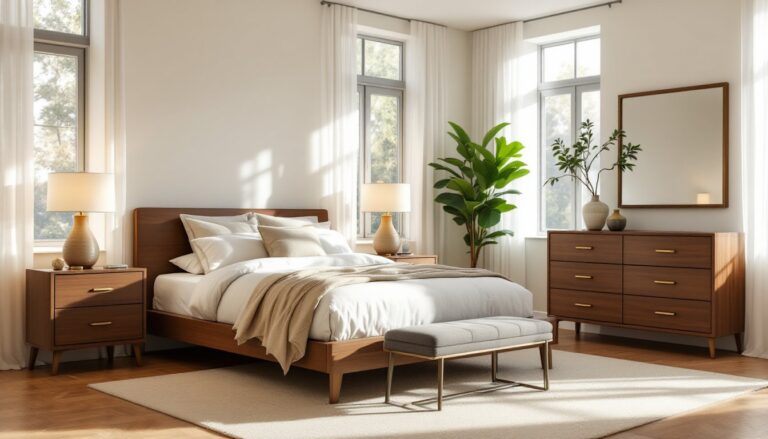
Layout starts with bed placement. Center the bed on the longest uninterrupted wall, leaving 24 to 36 inches of clearance on each side for nightstands and movement. Low-profile furniture creates horizontal lines, so vertical wall space above the headboard matters, leave it mostly empty or add one piece of large-scale art rather than multiple small frames.
Nightstand height should align with the top of the mattress, typically 24 to 26 inches for a platform bed with an 8- to 10-inch mattress. Matching nightstands create symmetry, but two complementary pieces work if they share wood tone and leg style.
Place the dresser opposite the bed or on an adjacent wall. Allow at least 36 inches of clearance in front for drawer access. If the room includes a mid century modern chair, common in larger bedrooms, position it in a corner with a floor lamp for a reading nook.
Rugs anchor the space. A large area rug (8×10 feet for a queen bed, 9×12 for king) should extend at least 18 inches beyond each side of the bed and past the foot. Natural fiber rugs in wool, jute, or sisal complement wood furniture without competing visually.
Lighting deserves careful attention. Swing-arm wall sconces mounted 24 to 30 inches above nightstands save surface space. Look for sconces with brass or black metal finishes and cone or globe shades. A Sputnik chandelier or globe pendant works as overhead lighting but install it on a dimmer, mid century bedrooms favor ambient light over bright overhead illumination.
Keep nightstand styling minimal: a small lamp, one book, and perhaps a ceramic dish for jewelry. Avoid cluttering surfaces with multiple decorative objects. The furniture itself provides the visual interest.
Where to Shop for Authentic and Reproduction MCM Bedroom Furniture
Authentic vintage mid century modern furniture appears at estate sales, antique malls, and online marketplaces like Chairish or 1stDibs. Prices for genuine pieces from makers like Broyhill Brasilia, Lane, or Bassett range from $400 for nightstands to $2,500+ for complete bedroom sets. Inspect joinery closely, look for dovetailed drawers, solid wood construction, and maker’s marks stamped inside drawers.
Authentic teak imports from Danish makers (Dyrlund, Skovby) command premium prices but offer exceptional craftsmanship. Expect $3,000 to $8,000 for a dresser. Check for wood stability: some imported pieces dried in European climates may crack in arid U.S. regions unless humidified.
Quality reproductions offer mid century aesthetics with modern construction standards. West Elm’s Mid-Century line provides FSC-certified wood options and ships assembled or flat-pack. Article manufactures platform beds and case goods that closely mimic 1960s Danish designs at mid-range prices ($800–$2,000 per piece).
For budget-conscious shoppers, Wayfair and Overstock carry numerous “mid century style” pieces starting around $300. Quality varies dramatically, read reviews and confirm solid wood construction. Many budget options use veneer over engineered wood, which works if properly constructed but won’t develop the patina of solid hardwood.
Local craftspeople sometimes build custom mid century furniture. Search for woodworkers specializing in period reproductions. Custom pieces cost more ($2,500–$5,000 for a bed frame) but allow exact dimension and wood selection. Request samples of joinery and finish before committing.
Whatever the source, verify return policies and inspect pieces immediately upon delivery. Scratches, dents, and poorly aligned drawers are common shipping damage that’s easier to address within the first 48 hours.